
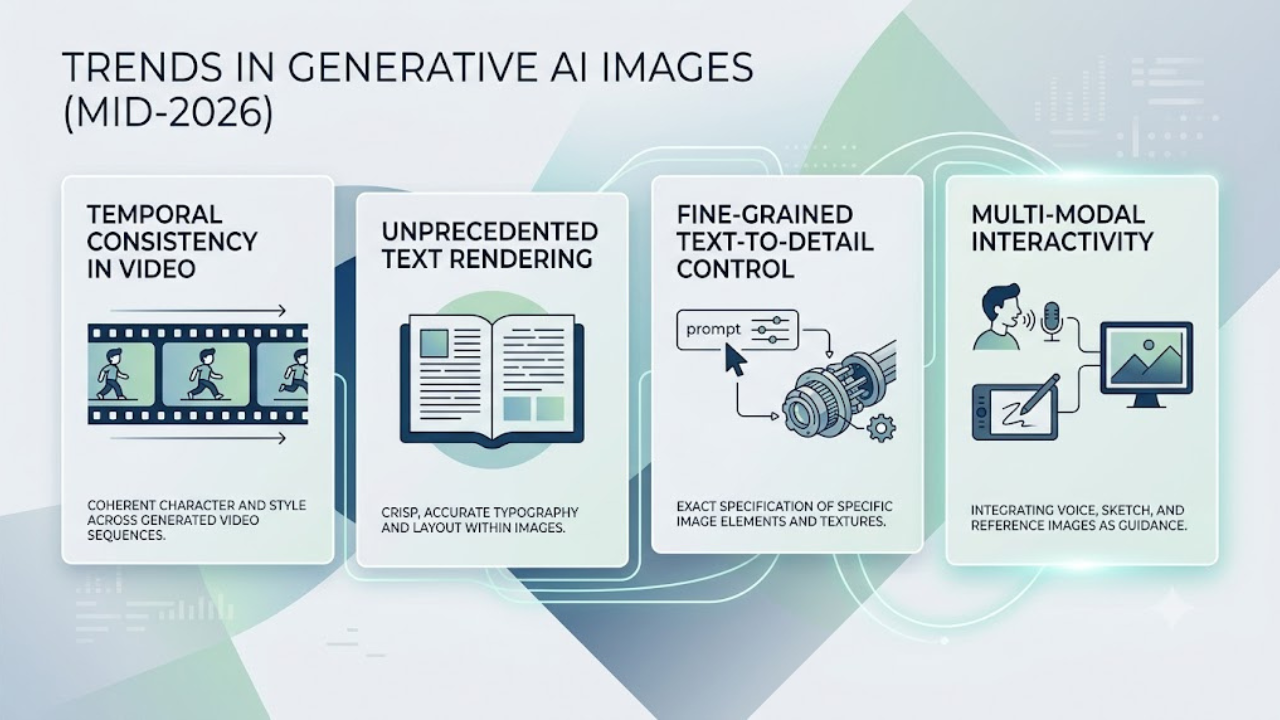
Here’s where things actually stand in generative AI image trends as of mid-2026, as I read it:
Images have basically solved “correctness” and moved on to speed and control. The old tells—mangled hands, gibberish text, melted faces—are essentially gone from the top-tier models.
The interesting competition now is happening on three axes:
1. Speed
Google’s Flash-based image models generate near-instantly and cheaply, which matters a lot for anyone doing high-volume product photography or ad variants.
Generating character lookalikes or brand assets across different poses, lighting conditions, and camera angles is now standard infrastructure.
2. Typography and Precision
Models are getting genuinely good at rendering legible text inside an image—posters, signage, UI mockups—which used to be the single biggest weakness of diffusion models.
Image platforms now feature precise spatial bounding boxes and depth controls, letting artists define exactly where subjects, backgrounds, and foreground elements sit before rendering.
The line between 2D digital art, 3D render passes, and AI generation has blurred, with models accepting depth maps, pose skeletons, and line drawings as primary guidance inputs.
3. Character/style consistency across multiple generations
Is what unlocks actual storytelling use cases like comics, brand campaigns, or children’s books rather than one-off pretty pictures.
Creators maintain persistent “Element Libraries” (saving characters, specific product models, art styles, and color palettes) that can be tagged directly into any image prompt to maintain 100% visual fidelity.
Editorial and artistic taste is still contested territory—there’s a real split between models tuned for photorealism and commercial usability versus models tuned for a distinct, painterly “house style” that artists gravitate toward.
I don’t think that split resolves anytime soon; it’s closer to a Nikon-vs-Leica taste question than a capability gap.
My honest verdict: images are in a maturation/consolidation phase—better, faster, cheaper, but not conceptually different from a year ago.
For my pick of the top 5 generative media AI tools in 2026, click here.
That’s a really interesting take, it makes sense that speed would become the primary focus after getting past the initial technical hurdles.