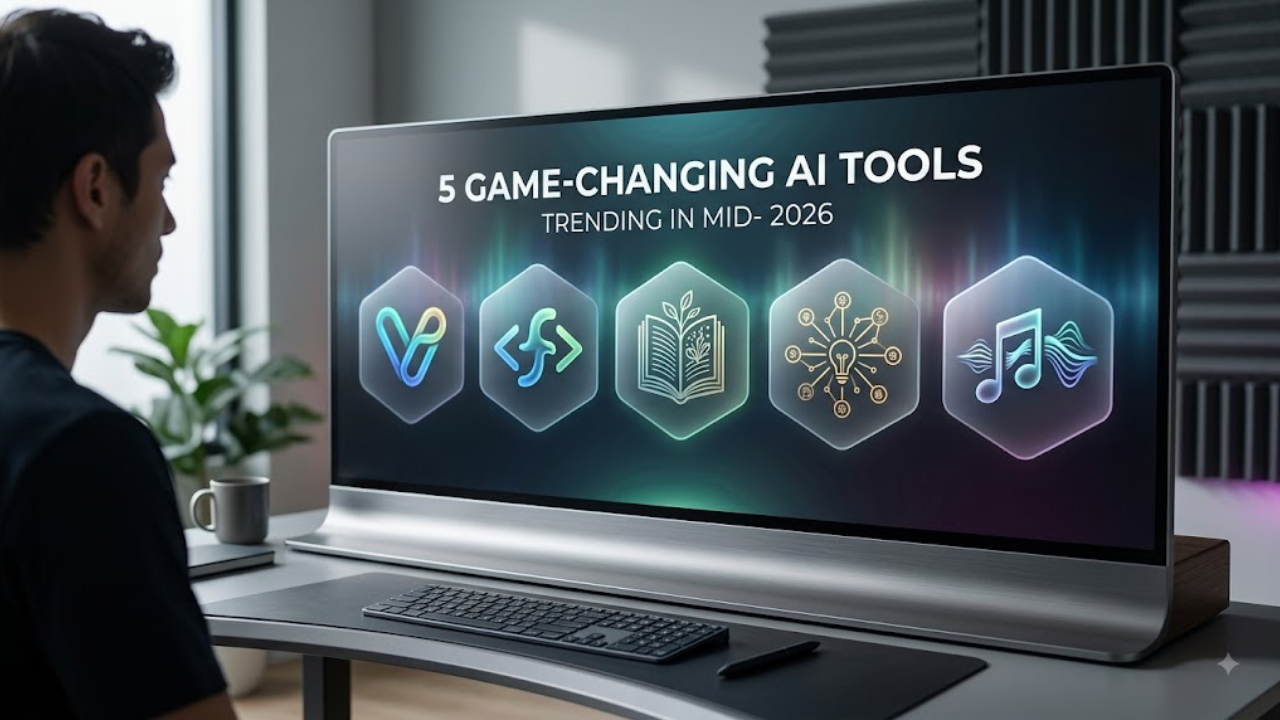
If you feel like the AI landscape shifts while you’re asleep, you’re not alone. August 2026 has brought a massive wave of updates, pushing creative tools, deep reasoning models, and production workflows into uncharted territory. We aren’t just looking at minor incremental updates anymore—we’re seeing tools that actively re-write how we code, generate cinematic video, and execute complex research in seconds. Whether you’re looking to streamline your content creation, automate heavy-duty codebases, or supercharge your daily research, these five buzz-worthy AI tools are dominating the conversation right now—and they deserve a spot in your toolkit.
1. Gemini Notebook
After rebranding from NotebookLM in July, Google’s source-grounded research assistant received a powerful upgrade: secure per-notebook code execution and data analysis for select plans. This builds on its robust June feature drop, which added advanced research tools and broad export support across PDFs, docs, charts, spreadsheets, JSON, and PowerPoint decks.
2. Google Flow
Google’s latest creative updates—introducing Gemini Omni, personal avatars, language-driven video editing, and Lyria 3.5-powered Flow Music—signal a major shift. It’s evolving past a simple video generator into a full-fledged, end-to-end studio for video and music production.
3. n8n
Workflow automation is seeing a massive resurgence as creators and businesses demand AI agents that directly integrate with real-world systems. Its August release introduced an AI Assistant and Agent Builder alongside expanded MCP and API support, capping off a series of 2026 updates focused heavily on agentic tools and integrations.
4. Claude Code
It’s shifting from passive code suggestions to fully supervised agentic workflows. With features like cross-session collaboration, background subagents, code review, and self-hosted environments, the platform is doubling down on automation—making “auto mode” the default for eligible paid plans starting August 14.
5. OpenClaw
As an open-source, self-hosted AI agent, this tool is making waves by executing complex, multi-step tasks locally or on private servers instead of just answering one-off prompts. NVIDIA highlights its local accessibility and flexible, unconstrained autonomy as the primary reasons behind its surging popularity.
My honest take: The AI space moves at a breakneck pace, but these five platforms prove that the real excitement right now lies in raw execution. We’ve officially moved past the gimmick phase into an era where AI tools act as genuine, high-powered creative and technical partners. The real question isn’t whether these tools are capable—it’s how fast you can weave them into your creative stack before the next wave arrives. Pick one or two that hit your biggest pain points, take them for a test drive this week, and see how much time you give back to your big-picture ideas.