
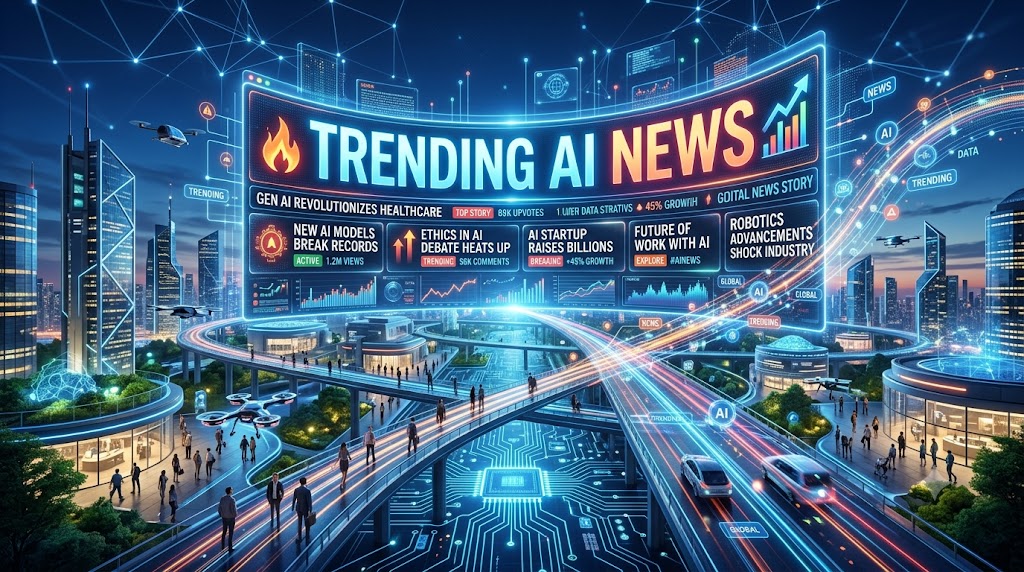
Here are the latest and trending AI news in Mid-2026
- OpenAI launched ChatGPT Work and GPT‑Live
OpenAI unveiled GPT-Live, a real-time voice model that can speak and listen at the same time, and ChatGPT Work, an agent made to carry out tasks across apps and files.
- xAI launched Grok 4.5 for coding and agents
With the release of Grok 4.5, xAI positioned it as its most competent model to date for agentic workflows and scripting.
- Meta opened Muse Spark 1.1 to developers
Muse Spark 1.1 was made available to developers by Meta, indicating a more aggressive approach to model distribution and platform rivalry.
- Anthropic released Claude Fable 5 and Sonnet 5
With the release of Claude Sonnet 5 (20–25B) and Claude Fable 5 (Mythos–class, up to ~70B), Anthropic expanded access to Fable 5 while making Sonnet 5 the default for many users.
- New York passed first AI‑ad disclosure law
A law requiring clear disclosure labels on advertisements using AI-generated synthetic performers was passed in New York, with fines of up to $1,000 for initial infractions and $5,000 for subsequent ones.
- US venture funding surged, with AI dominating
About 86% of the $412.7 billion that US startups raised in the first half of 2026 went to AI companies, demonstrating how important AI has become to investing.
- AI infrastructure and chip buildout accelerated
Major AI infrastructure initiatives were highlighted in reports, such as Micron’s larger U.S. investment plan linked to AI demand, Meta’s new data center in Alberta, and plans for chip production.
- Open‑weight AI got major backing
A group of tech executives publicly argued that open-weight AI is crucial for security, innovation, and competition.
- Copyright and safety enforcement tightened
In the continuing U.S. copyright issue, a group led by the New York Times requested that a court censure OpenAI, and Italy fined Character.AI’s owner has failed age-checks.
- Agentic AI and agents‑as‑a‑workforce took center stage
The focus of the coverage was on the transition of AI from chatbots to agentic systems, with studies highlighting the rapid expansion of long-running agent duties and forecasts that many firms will soon have more AI agents than people.
What this means
Agents, voice, governance, and infrastructure will define July 2026: models will become workers, regulations will catch up, and capital will focus on compute and AI-first businesses.

That’s really interesting about GPT-Live; it seems like the focus is shifting towards more interactive AI experiences.